Science Education, Communications, and Outreach:
An ECO-System Approach
Mark S. McCaffrey
Confucius is credited with the suggestion that if you are planning for one year, plant rice, planning for ten years, plant trees, but if you are planning for 100 years, educate children. But the immediate and long-term realities of climate and related global changes require planning and preparing for the a thousand years or more, since the steps taken (or not taken) in the years and decades to come will have a long tail lasting many centuries. To support the education, training, and public awareness efforts of Article 6 of the United National Framework Convention on Climate Change and related national and local efforts, an international network/consortium of climate education, communications, and outreach organizations and experts is needed that is coordinated through a central clearinghouse. Such a network, supported by a strong, well-funded backbone organization, will help develop, deploy, and integrate efforts to inform, engage, and prepare societies around the world for local, regional, and global changes already well underway.
Much has been written about the gap between society’s positive regard for science and admiration for scientists--who in the United States are second only to firefighters in careers that convey "very great prestige" according to a recent NSF survey—and the general lack of science literacy, especially relating to topics that fall under the umbrella of global change in general and the impact of and responses to human impacts on the climate system in particular.
The same NSF survey reported that 82% of Americans claim they understand the “global warming” issue “very well” or “fairly well,” but drilling down into the specifics, it is clear that knowledge of the underlying science is shallow at best. As Anthony Leiserowitz and colleagues at the Yale Project on Climate Change Communications have observed (2011), Americans lack detailed knowledge about the issue because few have actually had a formal course covering climate change, relying instead on bits of sometimes-contradictory information gleaned from mass media and other sources. Climate literacy varies around the world, with those who are better educated, wealthier, younger, and more communitarian than individualistic being more aware of and concerned about climate change than those who are not.
In the United States--which has the largest historic carbon footprint and currently has 80 million students making up 25% of the nation--climate illiteracy is caused by many factors. In addition to the fact that relevant crosscutting sciences are often not taught at all or not taught well, often falling through curricular cracks, there are other obstacles: the science is complex, spanning Earth, physical and life sciences and related mathematics; deliberately manufactured doubt and denial as to whether the planet is warming and humans are responsible has perpetuated confusion over the past several decades; and social numbing and motivated avoidance of “gloom and doom” and alarm is strong.
In recent years, a substantial climate communications cottage industry has developed in the United States, with substantial funding, particularly from private funders, focusing on how to fine tune messages to sway people's opinions about and spur action on climate change. Yet illiteracy about the causes, effects and risks of climate change remains high, with funding for climate education experiencing a boom, around 2009, when federal grants for curriculum development and professional develop were briefly made available, and bust, with federal funding now all but gone and philanthropic funding virtually non-existent.
It is worth reflecting on the fact that Article 6 of the UN Framework Convention on Climate Change, signed by the U.S. and over 150 other nations in 1992, called for: "(i) The development and implementation of educational and public awareness programmes on climate change and its effects;(ii) Public access to information on climate change and its effects; [and](iii) Public participation in addressing climate change and its effects and developing adequate responses." A few nations have taken these goals seriously--the Nordics and developed Asian nations come to mind as examples of high levels of acceptance of the science and support for policies to address them. But even many of them lack opportunities for the public to participate in "developing adequate responses" to climate change and run into their own issues of "motivated avoidance" of the topic.
There is another contributing factor to our collective scientific illiteracy about vital 21st Century challenges: the lack of coordination and integration between science education, communications and outreach (ECO), the three broad ways that science is transmitted to the public. To be blunt: we have attempted to rely on a siloed approach and haven't been methodical or scientific about how society can be informed and engaged, and we haven't been willing to fund efforts to do so. Attempts to rely on messaging rather than on an integrated approach have failed to fully inform or engage society at a level deep and wide enough to sufficiently prepare society. As one climate communicator has expressed, we are woefully unprepared as a society for the changes already underway.
The Education, Communications, and Outreach Domains
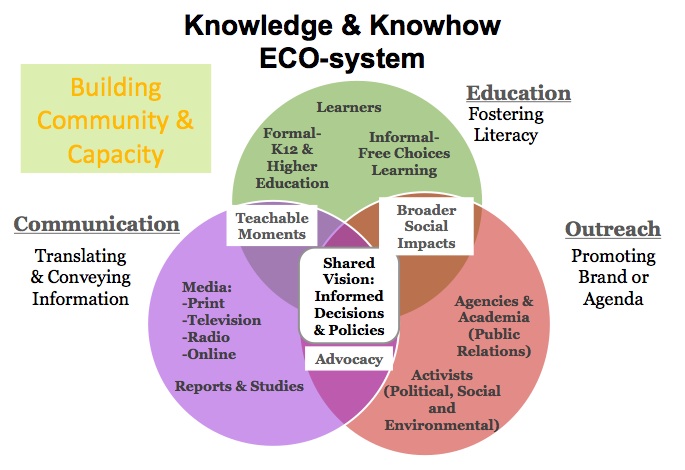
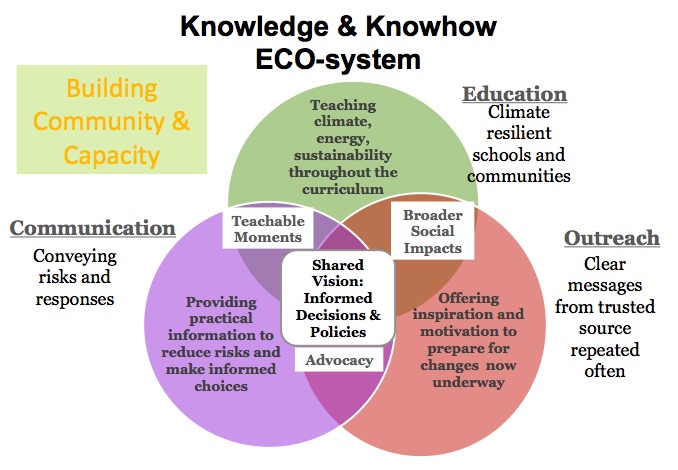
Imagine if you will a Venn diagram with the three intersecting circles representing the realms of education, communications and outreach. There is overlap between each of the circles and a “sweet spot” in the middle where the three come together. But before we imagine what that intersection might be, let us first briefly examine the domains, logic, assumptions and strategies of each.
Education, whether formal classroom, online or mobile, or informal and freely chosen, is ideally about building on prior knowledge, leveraging learning progressions, fostering skills and insights that will enable enhanced understanding and abilities to perform tasks or make decisions. Although education may include short “teachable moments” that can produce a “Eureka!” insight, it is ultimately a long-term, even a lifelong, process.
Education by its nature takes time, building on many "teachable" moments toward knowledge and mastery. The new Next Generation Science Standards in the United States, for example, introduce how human activities impact the environment at the elementary grades, examining how those impacts can be minimized through scientific inquiry. Weather and then seasonal changes are observed, and the differences between weather and climate are studied.
In middle school, the climate system is explored, and the ways that human activities, such as burning fossil fuels, affect the Earth system are detailed and modeled. By high school, global change, including rates of biodiversity loss, ecosystem disruption, as well as technological and engineering responses, are applied through a lens of whole systems thinking. These standards, meant for all students and shared between states that implement them, will take time to fully deploy, but they are already revolutionizing science education.
Today, however, the situation is different. While many nations with national curriculum usually include climate change, in the United States, with a hodgepodge of 50 state standards with wildly different coverage of global change science, it is easy for students to graduate from high school and even college without ever learning the essentials. The Six Americas research in 2010 found that more than two thirds of students report not learning a great deal about climate change in school and fewer than one in five feel they have a solid understanding of climate and energy science. A new study of secondary science teachers in the United States by the National Center for Science Education and Penn State's Eric Plutzer, (which in the spirit of full disclosure, I was involved with developing,) shows that now most science teachers at least touch on the topic, but how the topic is taught, emphasizing "both sides" of a phony scientific debate, leaves students unclear and confused about the causes and effects of recent global warming.
In comparison to education, communications and outreach tend to be short-lived and time-sensitive, usually to a specific event. Science communications in its purest form represents the conveyance of scientific information in a clear, concise manner that can reach and inform the intended audience, taking advantage of “teachable moments.” Think New York Times Science section or coverage of climate change in The Guardian: complex research scientific findings, breakthroughs, controversies, and insights are translated for the science attentive public, and scientists from other disciplines.
Communicators of science, even the best, struggle against the sheer tsunami of competing, sometimes contradictory information. And many who would like to communicate the science lack the skills to successfully calibrate their information for their intended audience; the “curse of knowledge” counters the best of intentions.
Outreach, on the other hand, tends to be more agenda-driven, designed to inspire action, foster awareness of a brand or goal, or in some cases simply amuse or provoke. Tweets or Facebook postings lend themselves outreach: short, sweet, and/or snappy. An institutional example of outreach: the "NASA Johnson Style (Gangnam Style Parody)” video on YouTube, which promotes a young and hip NASA brand and has received five million views. Another example is Bill McKibben and 350.org's “Do the Math” tour, which is focused on inspiring college students to advocate their schools divest from fossil fuel investments, which has been both praised as effectively empowering youth and criticized as over-simplifying complex issues.
On the “Do the Math” tour, McKibben emphasized numbers: 2°C of warming (“anything more than that risks catastrophe for life on earth,”), and 565 gigatons and 2,795 gigatons: the amount of carbon dioxide that in theory can be emitted to keep below 2°C, and the amount of carbon dioxide that would be released from the proven reserves of fossil fuels, according to Carbon Tracker. McKibben was attacked as being alarmist by those who promote doubt about the reality or implications of climate change, but also chided by some scientists who doubt the accuracy of the math itself. Sir Bob Watson in his keynote talk at the 2012 Fall AGU cautioned that 2°C is a political, not a scientific, point of no return, and that we are currently on a trajectory for a 4°C or warmer world by 2100.Over the past twenty years, in an effort to make up for the lack of relevant science in education, the often ad hoc attempts to communicate global change through media and disparate institutional outreach efforts have contributed to the cacophony of scattered bits of information and the lack of informed discussion about what can and should be done to minimize impacts and prepare for global changes now occurring on local scales.
In general, the three domains of education, communications and outreach operate as distinct silos in and around the scientific community, and the players involved often lack an understanding or appreciation of the other realms. Overall, there has been little coordination or cooperation between them, with rivalries and differing, sometimes competing agendas contributing to the discord.
Especially in the climate arena, communicators and outreach experts at times express little patience for science education as important to moving toward climate solutions, perhaps because of their own experience from a boring 11th grade science class that they day-dreamed through. They may feel that education simply takes too much time, that the urgency to address human impacts on the climate system requires pushing to promote policies and public opinion rather than investing in education. Certainly the numerous funders of climate communications and outreach efforts have not stepped up to support efforts like the White House's Climate Education & Literacy Initiative, which has identified important but often substantially underfunded climate education efforts. The reasons for the lack of philanthropic support for climate education in the United States range from "education is a black hole" to "the issue is too urgent and we don't have enough time to try to educate our way out of the crisis."
And many environmental education and "Green School" efforts have deliberately (and in my view unfortunately) avoided including climate change as important or integral components of their agendas, opting to avoid the "controversy" to promote their own goals-- outdoor, experiential education, or energy efficient schools--while ignoring the proverbial elephant in the room.
Meanwhile, educators and scientists may cringe at communications and outreach efforts that—often with the best of intentions—cut corners in representing the science or advocate an agenda, such as promoting or demonizing a particular mitigation or adaptation strategy, rather than fostering well informed decisions and discourse.
Toward an ECO-system approach
Given the varied perspectives and competing goals of education, communications and outreach, is there a "sweet spot" and room for synergistic collaboration and cooperation between these realms? The answer in a word is: absolutely. At the Climate and Energy Literacy Summit held in December 2012, educators, communicators, outreach specialists involved with energy, climate and global change science came together to explore the challenges and opportunities to “substantially and measurably increase climate and energy literacy” to improve individual and societal decision-making. Only through an integrated, reinforcing approach can such a goal, which would amount of a national strategy to meet the aims of Article 6 of the Convention, be achieved.
Among the recommendations of the summit was the use of the "Collective Impact" framework, a well-vetted approach that involves developing a common agenda, shared systems of measurement, mutually reinforcing activities, having continuous communication, all supported by a backbone infrastructure. This and related recommendations from the summit, which helped set the stage for the White House's Climate and Energy Literacy Initiative, are available here: http://bit.ly/101UBai.
The ECO-system model for integrating science education, communications and outreach lends itself to national and even international-scale goals put forth over twenty years ago in Article 6 of the Convention: doing everything necessary to prepare, inform, and engage youth and other vulnerable populations so they and their leaders can make informed climate and energy decisions based on scientific evidence and risk analysis. This is precisely the "sweet spot" of the education, communications and outreach intersection, it is around mutually reinforcing ways to honor the right of people to know about the causes, effects, risks and responses to global changes that are already well underway.
And as with any scientific undertaking, further research is required to determine the potential of the ECO-system approach, but in revisiting the Venn diagram, we can easily see why the sweet spots between the domains are so vital. Each domain needs clear goals. For education, they can include fostering climate and hazard resilient schools and learning centers that are true living laboratories for engaging youth and communities, building literacy over time with developmentally and culturally appropriate pedagogy. In communications, it is important to support strategies customized to meet the needs of specific communities and audiences, providing practical information for reducing risks and maximizing opportunities. And for outreach, the goals include continuing to inspire, motivate, pester and persuade through compelling messages from trusted sources.
Clearly, each of these is important, and the areas where they overlap are rich with potential to deepen and broaden knowledge and know-how. The ECO-system approach organized at the international level can bring a spirit of collaboration and cooperation that can help prepare society for global changes that are already changing the lives of people and altering ecosystems in every corner of the world. A consortium linking key climate education, communications and outreach organizations and experts together, with an existing center or university serving as the coordinating backbone, is the obvious next step toward supporting the goals of Article 6 of the Convention and building the necessary community and capacity to develop and deploy an integrated approach to preparing society for global change at a local level.
Contact: marksmccaffrey at gmail.com
National Science Foundation- Science and Technology Indicators- Chapter 7. Science and Technology: Public Attitudes and Understanding:http://www.nsf.gov/statistics/seind12/c7/c7h.htm
UNFCCC- Article 6: Education, Training, and Public Awareness- http://unfccc.int/essential_background/convention/background/items/1366.php